

If Hip-Hop were a kingdom, female rappers of the 90s and early 2000s would be its undisputed queens—women who didn’t just demand a seat at the table but built their own thrones.
Long before the explosion of social media and streaming services, these women pushed through an industry dominated by men, proving that lyrical prowess and raw talent had no gender.
From raw street poetry to flamboyant fashion and game-changing flows, these pioneering emcees laid the foundation for today’s female rap stars.
Let’s take a deep dive into the legendary female rappers who changed the game during Hip-Hop’s golden era.
1. MC Lyte

Although MC Lyte made her debut in the late 80s, her influence ran deep into the 90s. The Brooklyn native became the first female rapper to drop a solo album, Lyte as a Rock (1988), and continued to dominate with Act Like You Know (1991) and Ain’t No Other (1993).
Her precise delivery and socially conscious lyrics made her a force to be reckoned with. She wasn’t just about flexing skills—she rapped about real struggles, inspiring a generation of female MCs to embrace storytelling in their music.
2. Queen Latifah

While Hip-Hop was often drenched in machismo, Queen Latifah entered the scene with All Hail the Queen (1989), a project that carried anthems for women’s empowerment. The 90s saw her release Black Reign (1993), which featured U.N.I.T.Y., a bold call for respect that won her a Grammy.
Beyond music, Latifah shattered boundaries by becoming a Hollywood powerhouse, proving that female rappers weren’t confined to the mic alone. She was a trailblazer in every sense—spitting fire while building an empire.
3. Lil’ Kim

If MC Lyte and Queen Latifah fought for space, Lil’ Kim took that space and made it glamorous, raw, and unapologetic. Introduced by The Notorious B.I.G. as part of Junior M.A.F.I.A., Kim debuted as a solo artist with Hard Core (1996), an album that redefined what it meant to be a female rapper.
With sexually confident lyrics and an extravagant fashion sense, she became a trendsetter in both music and culture. Her 2001 album, The Notorious K.I.M., cemented her place as one of the fiercest women in Hip-Hop.
4. Missy Elliott

When Missy Elliott dropped Supa Dupa Fly in 1997, Hip-Hop was never the same again. Her futuristic beats, produced by longtime collaborator Timbaland, and her innovative videos made her a creative genius in the industry.
Albums like Da Real World (1999) and Under Construction (2002) showcased her lyrical versatility and ability to blend rap with R&B effortlessly. Missy wasn’t just an artist—she was a revolution.
5. Da Brat

Hailing from Chicago, Da Brat made history with Funkdafied (1994), becoming the first solo female rapper to achieve platinum status. Her brash, in-your-face flow set her apart, and she remained relevant well into the early 2000s with collaborations on tracks like Loverboy (Mariah Carey) and I Think They Like Me (Dem Franchize Boyz).
Unlike many of her female counterparts, Da Brat embraced a tomboy aesthetic and proved that Hip-Hop had space for every kind of woman.
6. Foxy Brown

If Lil’ Kim had a lyrical twin, it was Foxy Brown. The Brooklyn rapper burst onto the scene in 1996 with Ill Na Na, bringing an elegant but street-savvy persona to the rap game. As part of Nas’ The Firm alongside AZ and Cormega, she solidified her place in Hip-Hop history.
Her raunchy lyrics and bold attitude made her a major influence in the rap scene, proving that female rappers could hold their own alongside the best of them.
7. Eve
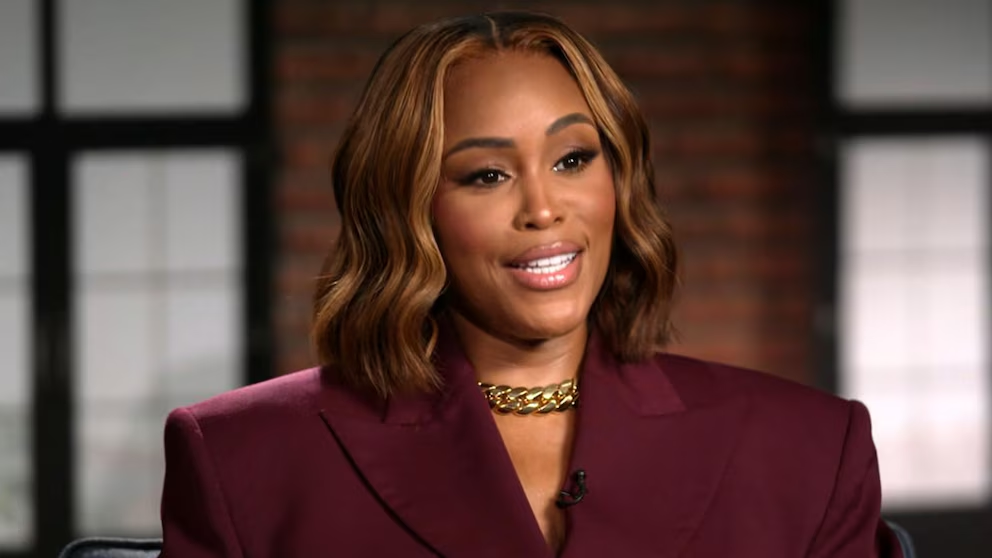
Coming up under DMX’s Ruff Ryders, Eve brought a fierce yet poetic style to Hip-Hop. With her debut album Let There Be Eve…Ruff Ryders’ First Lady (1999), she became the first female rapper to debut at No. 1 on the Billboard 200.
READ ALSO: Not Just Voices: Female Singers Who Became Movie Icons
Hits like Let Me Blow Ya Mind (with Gwen Stefani) and Love Is Blind showed her versatility—whether she was spitting hard-hitting bars or tackling serious topics, Eve was a powerhouse.
8. Lauryn Hill

Although Lauryn Hill’s rap career began with The Fugees, it was her solo project, The Miseducation of Lauryn Hill (1998), that set her apart as one of the greatest to ever do it.
With a mix of soul, reggae, and rap, she blurred genre lines and delivered timeless records that remain influential today. While she didn’t drop multiple rap albums, her lyricism and impact were undeniable.
Final Thoughts: The Legacy of These Queens
The 90s and early 2000s saw female rappers transform Hip-Hop from a male-dominated space into a dynamic, diverse culture. These women didn’t just rap—they shattered stereotypes, redefined femininity in Hip-Hop, and paved the way for today’s stars like Nicki Minaj, Cardi B, and Megan Thee Stallion.
Their legacy remains untouchable. Without them, Hip-Hop wouldn’t be what it is today.
Don’t miss out! Get your daily dose of Entertainment news and more straight to your phone. Join Ghana Street Journal Whatsapp channel now!